

Stop Explaining the Fish...Why stepping back is the parenting move no one talks about (but every child needs)
You don't need to optimize every moment. You can just watch. Watching is not lazy. You are choosing not to interrupt.

Last summer I sat on the beach with my husband, no kids. They are teens now, and off doing their teenage thing. I lay back in my chair, sun on my face, air pods in, and noticed the absence of a wiggling toddler in my lap giving me damp, sandy kisses. I miss those days something awful. I mean, sitting here without kids is nice, don’t get me wrong, but still… I miss my kids little.
My eyes scanned the beach. Vigilant parents stood guard at the water’s edge, sunblock at the ready, keeping their kids safe in the waves. I smiled as one mom picked spilled cheez-its off the towel, brushed off the sand, and fed them to her crying toddler. I nodded at her in solidarity.
Something felt off, though. The parents around me seemed to be working overtime, just to “get it right.”
They were parenting too hard. They jumped in to help, redirected, offered options, placated whining, and it was all with so much love and so many good intentions. But as I sat and took in the scene around me, I noticed that over and over, the efforts to optimize their child’s beach experience made things worse for everyone.

Let me back up before I explain. I have been there, not too long ago, in the best and worst ways. I over-optimized and burned myself out in the toddler years, especially with my oldest. I'm an early childhood educator. I know a lot about child development. But when it comes to our own kids? All bets are off.
Still, I have watched, over and over, what happens when adults step out of children's way. The play gets deeper. The kids get more capable. Eighteen years of parenting taught me to step back just enough to let my kids step forward.
Back to the beach…
A group of kids between four to eight years old, marched around the beach playground like a little gang of pirates. They had a whole plot going, that only they could understand. The metal swings were broiling hot, and there was some kind of make shift hideaway under the slide. The littlest one, trailing behind the big kids with a grin the size of Texas.
Two moms stood nearby, chatting animatedly about a novel they’d both read. Everyone looked settled.
Then a third mom walked up with a baby on her hip and called out, “Seth, honey. Don’t you want to play by the water? Want a snack? Some juice?”
Seth didn’t answer. He was deep in the game. But the other kids heard “snack,” and the energy shifted. They were like a flock of seagulls swarming a beach picnic.
Within a minute she was passing out Goldfish, chips, and carrot sticks to a band of sticky open palms. The toddler on her hip writhed toward a carrot stick while she pushed a sippy cup instead, explaining about choking, all while convincing a six-year-old to trade snacks with the crying four-year-old tackling his brother for the last bag of Doritos.
Everyone chewed in silence for one moment. I breathed out a breath I didn’t realize I as holding.
Then out came the bottle of sunscreen. “Let’s get sun-blocked,” she said to Seth, who was now digging through the open cooler. “I want a Capri Sun!” he whined. The mom looked to her husband, who had just settled the toddler onto the blanket with a board book and a paci, to grab the water bottles from the cooler.
Mom and dad looked tense. The playground game was long gone.
No one meant to disrupt anything. She just wanted her kids safe, fed, hydrated, and on track. Sound familiar? It does to me, because I was this mom. And it sucked. I hated feeling like I had to be the one keeping everyone safe, fed, sunblocked, and happy, all at once, all day. I worked that hard and still ended up with a crying toddler, a whining preschooler, and a husband I was snapping at.
Later in the day, after a lemonade I didn't have to share with a back-washing toddler, I watched a boy stand mesmerized by a man flying a fish-shaped kite. He was maybe five, curly dark hair, and sailboat swim trunks with a matching blue rash guard. The man noticed him and smiled. The two of them stood there together, strangers, curious about the same thing.
Then the boy’s dad came over. “Sammy, can you name that fish? It’s a clownfish. Can you say clownfish?”
Sammy looked away. His interest in the kite dimmed. His dad accidentally turned that moment of curiosity into a quiz.
Sammy went back to plucking tiny pebbles out of the sole of his crocs, and asked his mom for a snack.
His dad wasn’t done. He offered to walk Sammy closer to the man. He offered to buy Sammy a kite. He wanted to show him how to fly it. It was really nice, and it was so innocent, but it was too much. The moment was lost.
My point is this, and I wish I could go back and shake my younger self until I listened:
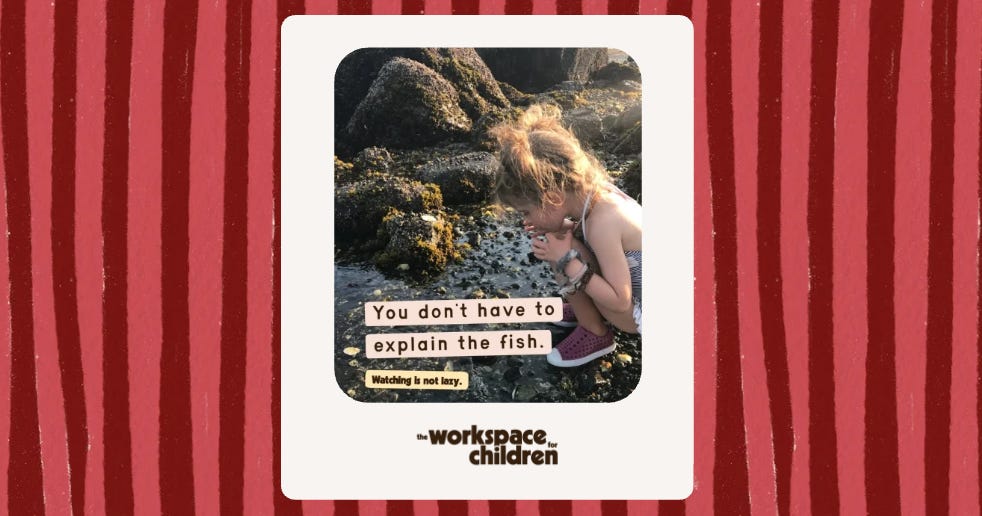
You don’t have to do more. You don’t have to optimize every moment or narrate every step. You don’t have to explain the fish. You can just watch. Watching is not lazy. You are choosing not to interrupt.
Step back and observe your child. Observation teaches you what lights them up. It lets you catch the flicker of interest before “being helpful” buries it. When your child takes the lead and stumbles, they build self-trust from their own discovery instead of your direction.
And you stop exhausting yourself improving things that were working fine.
Next time you’re at the beach, the playground, or your own living room, try this: don’t redirect. Don’t offer ideas. Just watch. And when they inevitable call to you for help, count to ten in your head before you step in. You might be surprised by how capable your child really is. And you might feel more peace than you expected.
I wrote the first version of this piece last summer, when I was newish to Substack, and still finding my footing. In the past year, I have come to find a real home here on Substack and today, this publication sits at #6 in best selling Parenting Substacks.
Thank you for allowing me into your sphere of parenting influence. I do not take it lightly. I am proud and humbled by the way this little piece of the internet has come to take shape.
I hope you’ll stick around, because there’s a lot more to come. x. Lizzie
Please leave a comment below. I read every single one.
Maybe College Kids Can’t Cope Because We Forgot to Let Them Play on Their Own

A therapist who works with college students recently told me something that stopped me in my tracks. She said her clients, smart, capable, raised-on-enrichment, tutors and club sports kids, are struggling with the same three things:
Something Playful: The Art Cart Edit

Something Playful is a paid series inside this publication. Each installment takes one type of play material (playdough, magnetic tiles, art supplies, sensory toys, chalk, bath toys, and more) and tells you exactly what to put out, how much, and what to do when it stops working. Age-by-age. No guessing.
This was so good! As a toddler mum and a teacher, it’s a really important reminder. It’s so easy to turn everything into forced learning rather than the free learning of play.
Wow I had almost exactly the same experience at a playground recently. I was with my daughter and I saw two boys around 3-5 yrs old playing with some big sticks. They told their adults, excitedly, “we’re fishing!!”. One of the moms started going on and on - “ooh! what kind of fish, do you know? Is it a salmon? Is it a trout? Describe it!” And I felt so deflated just overhearing it, like just let them play!! Why do we need to create a taxonomy of fish right now!! This is so affirming to read, and hilariously also fish-adjacent.