


My book But I’m Bored is available now...


“Can I play with you?”
Last week, I watched a little girl stand at the edge of the sandbox, clutching a slightly cracked, but still functional, purple unicorn bucket. She was about five, maybe a little younger. She had messy brown pigtails and Minnie Mouse Crocs. I watched her approach a group of slightly older kids creating a soupy mote out of sand, rocks, and an abandoned water bottle. They were tanned and dusty in a way that happens at the tail end of July.
After what felt like forever, she quietly said:
“Can I play with you?”
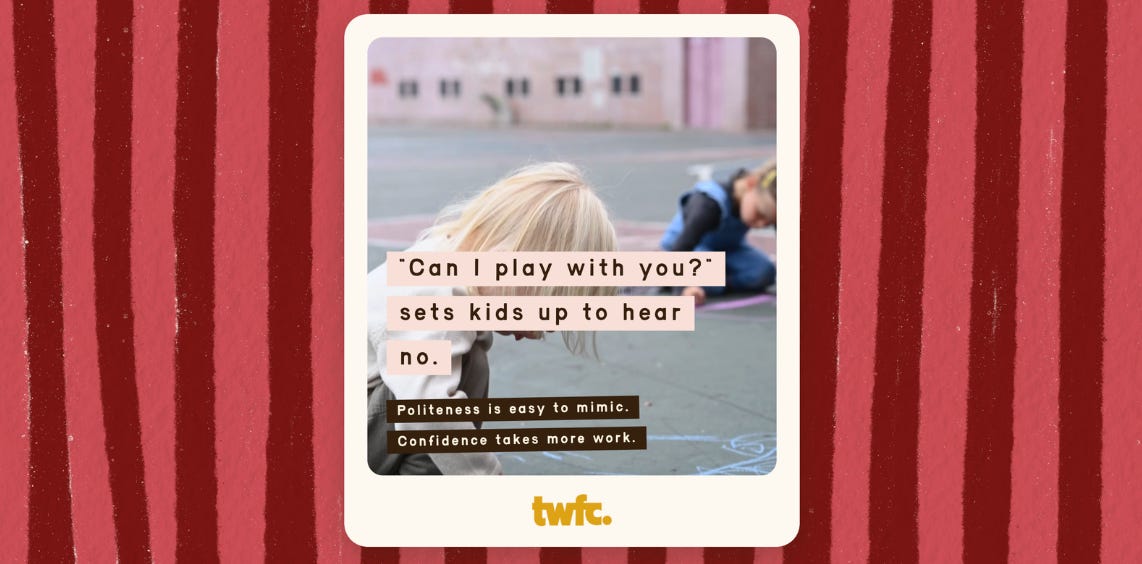
I felt a tingly bubble of pride climb up my chest watching her take control of her experience on the playground.
But the big kids barely looked up. One muttered, “No.”
Another: “We already have enough people.”
Shoulders slumped, she took her cracked bucket, wandered away, and started collecting pebbles near the corner of the playground.
I wanted to scoop her up and whisper, “It’s not you, it’s development.”
We all teach our kids to ask permission because it seems like the kind and polite thing to do. But what if this well-meaning approach is setting them up for rejection?
I spent years in the nursery school classroom observing children at play, studying what landed and what didn’t. As a team of teachers, we constantly talked about which phrases helped kids “get in the game” and which ones left them feeling dejected.
"Can I play with you?" is a yes or no question. Kids deep in a game almost always say no.
It sounds kind, friendly, cooperative, but it rarely lands.
Here's why, and how to give your child tools that significantly increase their chances of successful play entry.
The rest is for my paid subs…
Not a paid sub yet? Here is a free seven day trial.
