


My book But I’m Bored is available now...


When my youngest was an infant, winter felt endless. She was a NICU baby, and I was terrified to take her outside in anything but ideal weather. At the same time, I had a five-year-old and a three-year-old coming home from school completely full of energy.
They needed to jump.
They needed to fidget.
They needed to move their bodies in big, physical, LOUD ways.
There was no version of reality where they were going to sit quietly coloring while I fed and soothed a newborn. And heading outside every afternoon wasn’t always an option.
So I had to figure out how to meet their need for movement indoors, without turning our home into a safety hazard or asking them to regulate themselves without support.
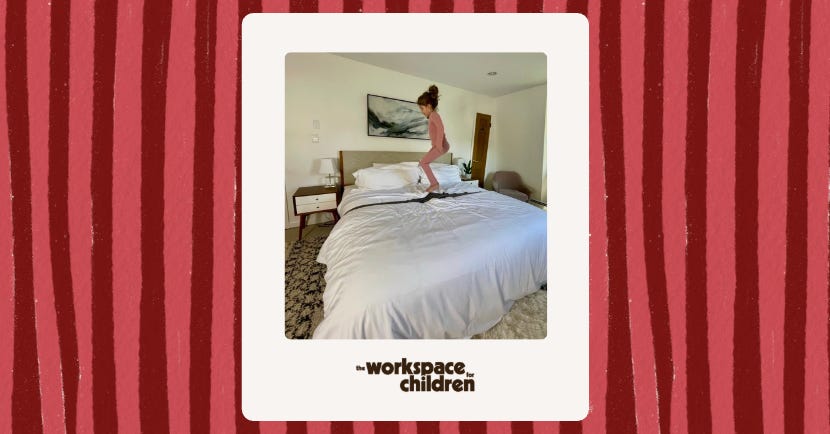
Why movement matters
Children need movement and sensory input in order to regulate. When they don’t get it, you will know.
Restlessness, impulsivity, emotional blowups, constant seeking. These are often signs that a child’s body needs more input, not more correction.
One shift that made a big difference for us was focusing on maximum output.
Not just moving, but choosing activities that actually work the body (and mind) hard enough to meet the need.
Heavy work helps. Carrying full laundry baskets. Moving chairs. Lifting and organizing pantry items. Any activity that uses both the mind and body tends to be more regulating than unstructured chaos.
Deep pressure can help too. Gentle squeezing, massage, or “playdough” games where you mold your child’s body can calm a nervous system that’s craving movement.
What you’ll find in this post
Four indoor gross motor activities you can set up quickly and repeat often
Ways to channel big energy safely inside, even in small spaces
How to increase impact using simple tools like a belly scooter
A curated list of movement toys that grow with your child
Options that work across ages and stages, without constant oversight
The indoor activities and product recommendations are below for paid subscribers.
Three indoor activities that really work
Obstacle courses
Push the rug aside. Move the coffee table. Use blocks, painter’s tape, couch cushions, stools, or whatever you have.
Set things up in a zig-zag or looping path and invite your child to step over, crawl under, or jump across.
You can time them, add music and freeze moments, or change the course together. Once kids learn the pattern, they often start setting it up on their own.
Creative racing (not running wild)
Use painter’s tape to create paths on the floor or rugs. Make loops, zigzags, or long routes through hallways.
Invite kids to hop the course, crab walk, walk backward, count heel-to-toe steps, or take giant lunges from start to finish. The structure gives movement purpose and helps it last longer.
Upside-down drawing (a favorite regulation reset)
When things were getting too wild and we couldn’t go outside, this was one of our go-to activities both at home and in my preschool classroom.
Tape large sheets of paper to the underside of a sturdy table. Have your child lie on their back underneath it and draw upside down.
They love it.
It challenges their brain and body at the same time, which is often exactly what a dysregulated kid needs. There’s something about the position, the change in perspective, and the full-body engagement that helps everything slow down without shutting play off completely.
It’s especially helpful in the late afternoon or early evening, when energy is high but you’re heading toward a calmer part of the day.
Define a safe movement zone
When my kids were stir crazy, they’d always get hurt. A chin to the coffee table, a forehead to the block shelf… I know you know. Here’s how I helped myself feel a little better when they needed to be wild and silly.
Designate a clear area using painter’s tape or a baby gate. Inside this space, jumping, spinning, dancing, and flopping are all allowed.
This removes the constant worry about furniture, siblings, or sharp edges and makes big movements easier to say yes to.
Add a belly scooter for maximum impact
A scooter board makes every activity above more effective. Kids can pull themselves through obstacle courses, tow books or blocks, or take turns pulling each other. It’s heavy work, coordination, and play combined.
Set one clear rule: bellies or bottoms only. No standing. If the rule isn’t followed, the scooter takes a break. We kept our scooter hanging on a nail on the wall in our kitchen… that’s how much we used it and loved it. Plus, when it “needed to take a break,” it was easy for me to hang it up.
Don’t be discouraged…
Even with the best indoor setup, sometimes the answer really is to go outside. Even for a few minutes. Active kids usually come back calmer than they left.
Toys for kids who need to move
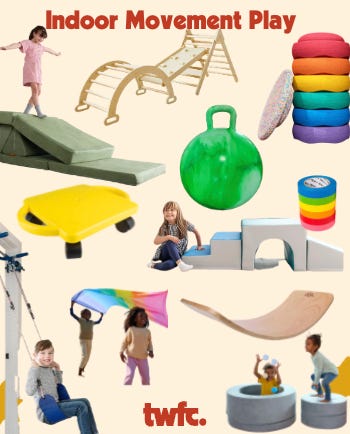
Active kids are climbers, jumpers, spinners, and builders of obstacle courses that take over the living room. Their bodies are their primary learning tool.
These tools support gross motor development, balance, coordination, and spatial awareness across ages and stages.
Climbing and Crash Play
These are the kinds of tools that let kids move their bodies fully without you constantly worrying about safety or damage. They invite big movement, experimentation, and risk in a way that’s contained and repeatable.
Nugget Comfort Play Couch
Go ahead, play on the furniture. This foam couch ships fully assembled and includes four pieces in machine-washable fabric.
Why I chose it: It keeps up with kids. It’s a crash pad for toddler energy, a fort for preschoolers, a hangout spot for sleepovers, and a comfortable place for grownups too. It earns its footprint.
Chunk Play Ottoman
A four-piece ottoman that nests, stacks, and lounges.
Why I chose it: Crash pad, builder, and calm corner in one. It works for big movement and then transitions easily into rest time without needing to be put away.
Kids bounce, scoot, spin, and invent their own movement games with this one. It’s simple and physical in a way that invites big body movement without a lot of setup.
Why I chose it: A great outlet for kids who need to move hard and rhythmically. The grabbing handle adds a sense of control and safety, and the bouncing gives strong proprioceptive input that helps many kids regulate. It works indoors or out, gets used again and again, and fits nicely into the 3–7 window without feeling flimsy or babyish.
Waldorf Original Wooden Balance Board
Toddlers crawl over it, roll balls underneath, and climb across it again and again. Older kids use it as a bridge, slide, balance tool, or something entirely new.
Why I chose it: This is one of those rare toys that gets used differently every year. It builds core strength, balance, and body awareness from toddlerhood through elementary years and beyond.
Scooter Board with Handles
A sturdy board with 360-degree swivel wheels for indoor movement games.
Why I chose it: It channels energy into coordination, strength, and teamwork. Especially helpful on days when kids need to move but going outside isn’t realistic.
Original Rainbow Stones
Stack them, balance on them, jump between them, or build obstacle courses indoors or out.
Why I chose it: A gross motor staple that scales beautifully. Toddlers step carefully, preschoolers jump, and older kids turn them into complex balance challenges.
Indoor Active Play for Small Spaces
These are especially helpful when you don’t have a lot of room but still want meaningful movement.
XXL Play Silk
An open-ended staple for dramatic play.
Why I chose it: From capes to tents, play silks invite movement through imagination. Kids are running, jumping, building, and acting things out.
Doorway Gym
A doorway-mounted swing, rings, and rope ladder system.
Why I chose it: It brings climbing and swinging indoors without taking over your house. Especially helpful for kids who seek vestibular input.
Indoor Folding Slide
A compact wooden slide for toddlers.
Why I chose it: Just the right height for confidence-building climbing and sliding. It folds flat when not in use and doesn’t scream “playroom.”
Pikler Triangle Climbing Set
A solid wood climbing system with multiple configurations.
Why I chose it: This is the kind of toy that earns its keep. Crawling babies, bold toddlers, and energetic preschoolers all find new challenges here. It grows with your child and supports real physical development.
Active play doesn’t have an expiration date. A balance board that challenges a toddler becomes a stretching tool for an older child. A play couch that’s a crash pad at three becomes a reading nook at eight.
These are investments in movement, independence, and confidence, now and for years to come.
These are the things that helped us when we were inside a lot and everyone had too much energy. Some of it will click for your kid. Some of it won’t.
If one idea makes the afternoon go a little better, that’s enough. Keep that one. Forget the rest.
And sometimes the answer is still going outside for a few minutes, even when it’s annoying and feels like more work.
One more thing… Thank you all for your support around the book launch. If you haven’t ordered, But I’m Bored, what are you waiting for?! It also makes a great gift for your child’s teacher.
If you have bought it, would you please do me a favor and leave a review on Amazon? It would only take a minute or two, and it would mean the absolute world to me.
I appreciate you all so much.
x. Lizzie
PS We put together a Spotify playlist of some of the podcast interviews I’ve done, where we chat all about boredom and play. Listen in here.
We have a decently long hallway for running and lately have been playing “Olympics” - we call out a sport and he pretends to do that sport while running down and back up. It’s a frequent after dinner activity!